


What if the most important feature of a DeFi wallet is not how quickly it signs a transaction, but how much it helps you understand before signing? That question changes the way Rabby Wallet should be evaluated. It is often presented as an alternative to MetaMask, but the more meaningful comparison is not a contest between interfaces. It is a question of whether a wallet can reduce the gap between what a user intends to do and what a smart contract will actually execute.
For German-speaking DeFi users, that gap matters. A single browser session may involve Ethereum, Arbitrum, Base, Polygon, Optimism, Avalanche, or the BNB Chain. Each network has different applications, gas conditions, bridges, and contract risks. Rabby is designed around this multi-chain reality, supporting more than 140 EVM-compatible networks and automatically switching to the network requested by a decentralised application. Convenience is valuable, but it should not be confused with security. Automation removes friction; it does not remove the need for judgement.
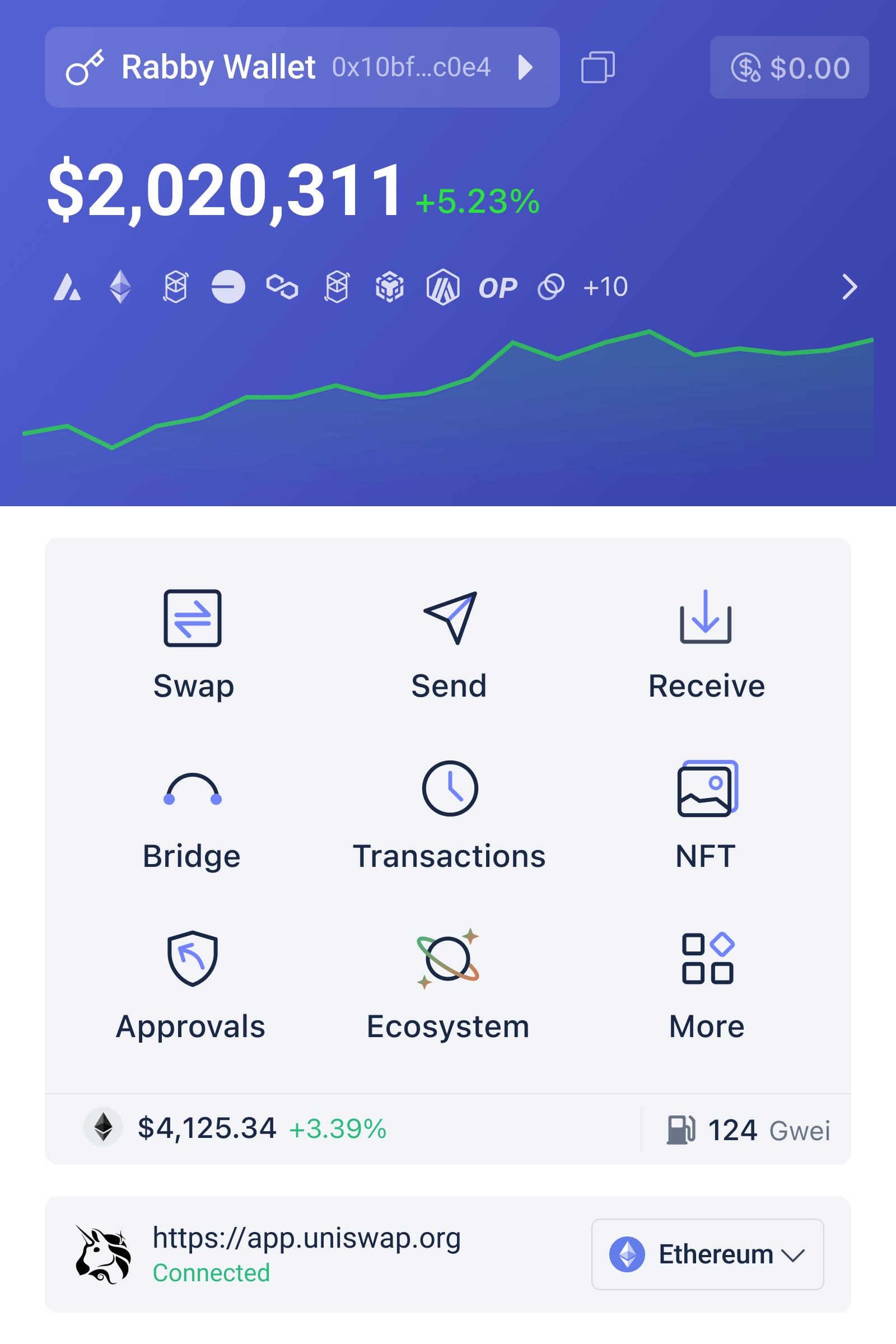
Why transaction simulation changes the wallet’s role
A conventional wallet can be understood as a signing instrument. A decentralised application prepares a transaction, the wallet displays some technical information, and the user approves it with a private key. Transaction simulation adds another layer. Before signing, Rabby attempts to model the expected result of the transaction and presents the anticipated changes to token balances. In practical terms, the user may see that a swap should remove one asset and return another, or that an approval would grant a contract permission to spend a token.
This is more than a cosmetic display. Smart-contract transactions are instructions, not promises written in plain language. A button labelled “claim,” “deposit,” or “mint” may produce an outcome that is difficult to infer from the button itself. Simulation translates part of the transaction’s execution into a user-facing consequence. The useful mental model is therefore not “the wallet guarantees that this transaction is safe,” but “the wallet provides a pre-execution hypothesis about what the transaction will do.” That distinction is essential.
Simulations have boundaries. They depend on the transaction being simulated correctly, on the relevant network state, and on the behaviour of the contracts involved. State can change between simulation and execution. A contract may contain unusual logic, depend on external conditions, or behave differently when called in another context. A successful simulation also does not prove that the recipient is trustworthy, that the asset has economic value, or that a bridge carries acceptable counterparty and smart-contract risk.
Rabby’s integrated security engine complements simulation by scanning contracts and addresses for indicators such as phishing, known compromises, and potentially unlimited token approvals. These warnings can be useful precisely because many DeFi losses occur through ordinary-looking approvals rather than dramatic transfers. Yet a warning system is best treated as a filter, not as an insurance policy. It may identify known or detectable risks while missing a new exploit, a malicious upgrade path, or a project whose danger is economic rather than technical.
Rabby Wallet herunterladen safely: the first security decision
Searching for “rabby wallet herunterladen” may seem like a trivial step, but the download process is part of the security model. A non-custodial wallet places the private keys locally on the user’s device rather than sending them to Rabby’s servers. That means the user retains control, but also responsibility. A counterfeit browser extension, a manipulated download page, or a fake support message can undermine every later safety feature before the wallet is even used.
Users should therefore treat installation as a verification task rather than a routine software download. The relevant extension or application should be obtained through an official distribution route, and the publisher details, permissions, and installation source should be checked carefully. The seed phrase must never be entered into a website, shared with support, or stored in a cloud note. A password protects access to the local wallet installation; it does not replace the recovery phrase.
Rabby is primarily available as a browser extension for Chrome, Brave, and Edge, with desktop versions for Windows and macOS and mobile applications for iOS and Android. The broader availability is practical, but it also creates more opportunities for impersonation. Users should avoid assuming that an application is genuine merely because its name and logo look familiar. Open-source software, released under the MIT licence, allows public inspection of the code, which is a meaningful transparency benefit, but open source alone does not guarantee that every release channel, dependency, or user device is secure.
Multi-chain convenience versus multi-chain complexity
Rabby’s strongest design argument is that it treats EVM activity as a connected environment rather than a collection of isolated networks. Automatic network switching can prevent a common operational mistake: attempting to use a decentralised application while the wallet is connected to the wrong chain. Integrated bridge functionality, including routes using protocols such as LI.FI, can also make cross-chain transfers less fragmented. An integrated swap aggregator can scan venues such as Uniswap and 1inch to seek competitive routes and lower slippage, the difference between the quoted price and the effective execution price.
But an easier interface can hide a more complicated risk surface. A bridge route may involve several contracts, a token representation on the destination chain, and assumptions about liquidity. The route with the best displayed exchange rate may not be the route with the lowest overall risk. Similarly, an aggregator’s price comparison does not eliminate price impact, failed transactions, approval exposure, or the possibility that a user is interacting with an unfamiliar application. Multi-chain users should ask not only, “What will I receive?” but also, “Which contracts will I authorise, on which networks, and under what assumptions?”
The Gas Account feature illustrates the same trade-off. Paying network fees with a stablecoin such as USDC can solve a familiar usability problem: a user has funds on a chain but lacks its native gas token. That is valuable during time-sensitive activity, especially across several EVM networks. Still, the feature is not free abstraction. Users should understand the conversion, service, and execution conditions behind the payment method, and they should not interpret stablecoin-based gas payment as evidence that the underlying transaction is low risk.
Where Rabby fits beside other wallet choices
MetaMask remains a familiar general-purpose option and has a large user base, broad dApp recognition, and an established workflow. Its familiarity can be an advantage for users who value a simple, widely recognised entry point. Rabby’s distinction is more specific: it puts multi-chain DeFi context, transaction simulation, and expanded risk warnings closer to the centre of the user experience. The trade-off is that more information can also mean more decisions. A richer warning and simulation interface is helpful only if the user pauses to interpret it.
A hardware wallet such as Ledger, Trezor, or OneKey addresses a different part of the problem. It isolates key operations from the everyday browser environment and can materially improve protection against some forms of malware and unauthorised local access. It does not, however, understand every economic or contractual risk in a DeFi transaction. Connecting a hardware wallet to Rabby can combine stronger key custody with a more informative transaction review, but the final decision still belongs to the signer. Secure key storage and informed signing are complementary controls, not substitutes.
Users who prefer a highly controlled or single-network workflow may choose a more specialised wallet or use direct application-specific tools. Such arrangements can reduce interface complexity and limit exposure to unfamiliar chains, but they may sacrifice Rabby’s automatic network switching, cross-chain facilities, or broad EVM coverage. There is no universally safest wallet. The better choice depends on which failure is most likely for the individual: losing control of keys, signing an unintelligible approval, using the wrong network, or chasing convenience across too many protocols.
A practical review framework for DeFi users
A useful way to evaluate any wallet is to separate four questions. First, who controls the keys? Rabby is non-custodial, with private keys stored locally, so the user controls signing but also bears recovery responsibility. Second, what does the wallet show before signing? Simulation and security warnings improve visibility, although neither is conclusive. Third, what can the wallet connect to? Rabby’s EVM coverage and dApp-oriented features create flexibility, while also expanding the number of networks and contracts a user may encounter. Fourth, what happens when the wallet’s supporting services are unavailable?
That last question is often overlooked. Rabby is described as an independent checker that does not itself create or alter transactions, and core signing functions can remain usable if Rabby’s servers are unavailable. This separation is important: an interface can provide analysis without being the custodian of the private key. Nevertheless, service outages may affect convenience features such as data retrieval, warnings, or route discovery. The correct conclusion is not that the wallet is independent of all infrastructure, but that key control and basic signing are not wholly dependent on Rabby’s backend.
Before signing, inspect the expected asset changes, the receiving address, the network, the contract permission, and whether an approval is limited or effectively unlimited. For a bridge, add the source and destination assets, the route, and the trust assumptions. For a swap, consider slippage and liquidity rather than relying only on the headline rate. For a newly encountered protocol, an absence of a warning is not a positive security certification. This checklist is deliberately slower than clicking through a transaction, but it converts a vague sense of safety into observable conditions.
Rabby Points, earned through activities such as swaps, gas top-ups, or referrals, may make the product more engaging. Users should keep incentives separate from security evaluation. A points programme can influence behaviour by encouraging more interactions, and more interactions create more signing opportunities. The rational question is whether a feature improves control and comprehension, not whether it rewards activity. In DeFi, a small reward is rarely compensation for an avoidable approval or an irreversible transfer.
What to watch as wallet safety evolves
The recent positioning of Rabby as a broadly useful wallet for Ethereum and EVM networks reflects a wider direction in DeFi: wallets are becoming interpretation layers, not merely key managers. If simulation becomes more accurate, more intelligible, and more consistent across applications, users may be able to evaluate complex actions without reading raw calldata. That would be a meaningful improvement. The open question is how these systems handle rapidly changing contract state, novel attack patterns, and transactions whose principal risk is financial rather than technical.
A conditional scenario is worth monitoring. If wallets combine reliable simulations, hardware signing, clear approval controls, and transparent route information, multi-chain self-custody could become easier to use without becoming purely automated. If interfaces instead reduce every warning to a green badge or encourage users to approve unfamiliar routes quickly, convenience may outpace understanding. For German users navigating a fragmented EVM market, the decisive advantage will probably not be the largest network list. It will be the quality of the explanations shown at the moment when an irreversible decision is made.
Frequently asked questions
Does Rabby transaction simulation guarantee that a transaction is safe?
No. Simulation estimates the expected state changes before signing, which can reveal unexpected transfers, approvals, or failed outcomes. It cannot guarantee the honesty of a contract, the value of a token, the stability of network state, or the absence of a new exploit. Treat it as a powerful review aid, not as a guarantee.
Is Rabby a suitable alternative to MetaMask?
It can be, especially for users who work across several EVM networks and want integrated simulation, security warnings, automatic network switching, and hardware-wallet compatibility. MetaMask may remain preferable for users who prioritise familiarity or a specific established workflow. The choice should follow the user’s risk profile and habits rather than brand preference.
What is the safest way to download Rabby Wallet?
Use a verified official distribution route and check the publisher and requested permissions before installation. Never share the seed phrase, never enter it into a website, and consider a Ledger, Trezor, or OneKey device for higher-value activity. The rabby wallet extension should be treated as a security-critical application, not an ordinary browser add-on.
Rabby’s central promise is therefore best understood as improved decision visibility. Its value lies in showing what a transaction is expected to change, warning about identifiable risks, and reducing the operational friction of EVM-based DeFi. Its limits are equally important: no wallet can replace careful contract selection, key hygiene, or financial judgement. The safest multi-chain workflow is not the one with the fewest clicks. It is the one in which the user can explain, before signing, what will happen, why it is happening, and which risks remain unresolved.